Helping people feel happier and healthier with digital health assessments.
Background
LiveSmart provides remote, digital-first health MOTs and one-to-one health coaching to help businesses feel happier and healthier. As a B2B product, LiveSmart have two main user types: buyers (HR professionals) and end-users (employees). LiveSmart operates in the UK, France and Malaysia.
Brief
To redesign LiveSmart’s website and support business growth by improving the content, navigation and tone of voice. The key aim was to better communicate to HR professionals – our primary audience for this project – the reasons why their company should invest in a LiveSmart health assessment.
I formed part of a working group consisting of LiveSmart’s Head of Product, members of the Clinical, Technology and Service Delivery teams, a Brand Consultant and a Copywriter who specialises in health innovation products.
Goals
Business goals
- To develop and communicate our brand positioning in order to increase trust in LiveSmart
- To increase the percentage of HR professionals that request a free product demo
- To increase sales and support business growth
- To increase the percentage of staff uptake at company rollout
User goals
HR professionals (primary users) want to understand what LiveSmart is, the differences between health assessments, and whether it fits their budget, preferences and company objectives. Employees (secondary users) want to understand whether LiveSmart fits their needs and preferences.
Journey mapping
Below is a journey map that identifies the stages of the end-to-end LiveSmart experience for HR professionals. The redesign aims to make the ‘Find out about LiveSmart’ stage as delightful as possible for our customers.
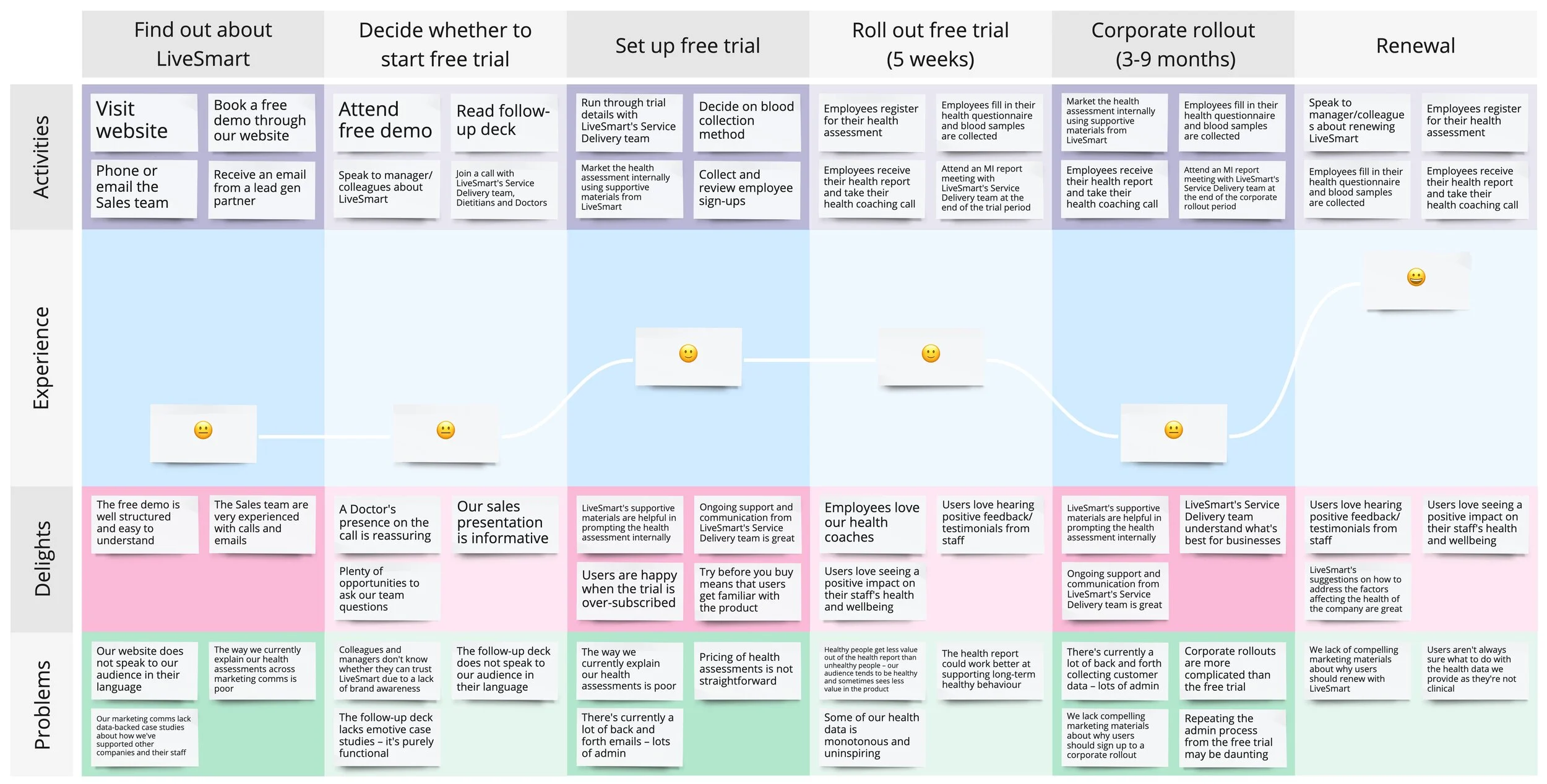
Pain points
Brand positioning
LiveSmart doesn’t have a tone of voice guide and current brand messaging is poorly crafted for our different user types – we are unclear about who we’re speaking to, which makes us feel untrustworthy.
Navigation
New webpages have been introduced for different user types without full reviews of overall content and design, so navigation has become muddled. It’s also not possible to navigate from the UK site to the French and Malaysian sites.
Explaining health assessments
We currently use blood readings to differentiate our products – but our audience doesn’t understand or need this information at the early stages of their purchase journey.
Customer stories
Our existing website lacks a variety of engaging, data-backed case studies, which both audiences highly value.
User interviews
I started by interviewing five senior HR professionals from different sectors via Google Meet, to understand when and where they look for new health and wellbeing benefits, what motivates them to purchase, their sign-off process, and what sources they use for HR news.
Key findings
- Participants most commonly search for ‘health and wellbeing initiatives’ on Google, and seek advice from HSE, CIPD and local LinkedIn networks: “I want to know that somebody else in my position thinks it’s good.”
- Companies look for new health and wellbeing opportunities at various times throughout the year, depending on busy seasons and budget reviews.
- Purchase decisions are led by the wellbeing of both staff and business – inclusivity is really important.
- All participants were responsible for researching, proposing and implementing benefits, and needed to present to Leadership in financial terms for sign-off.
- The most popular sources of HR news are CIPD, Disrupt HR, XpertHR, People Management Magazine, Sage HR, HR Magazine and Grapevine.
Prioritisation workshop
I ran a remote prioritisation workshop with 15 senior HR professionals using Miro and Lookback, to validate assumptions about our buyer audience and identify what HR professionals want from a staff health benefit.
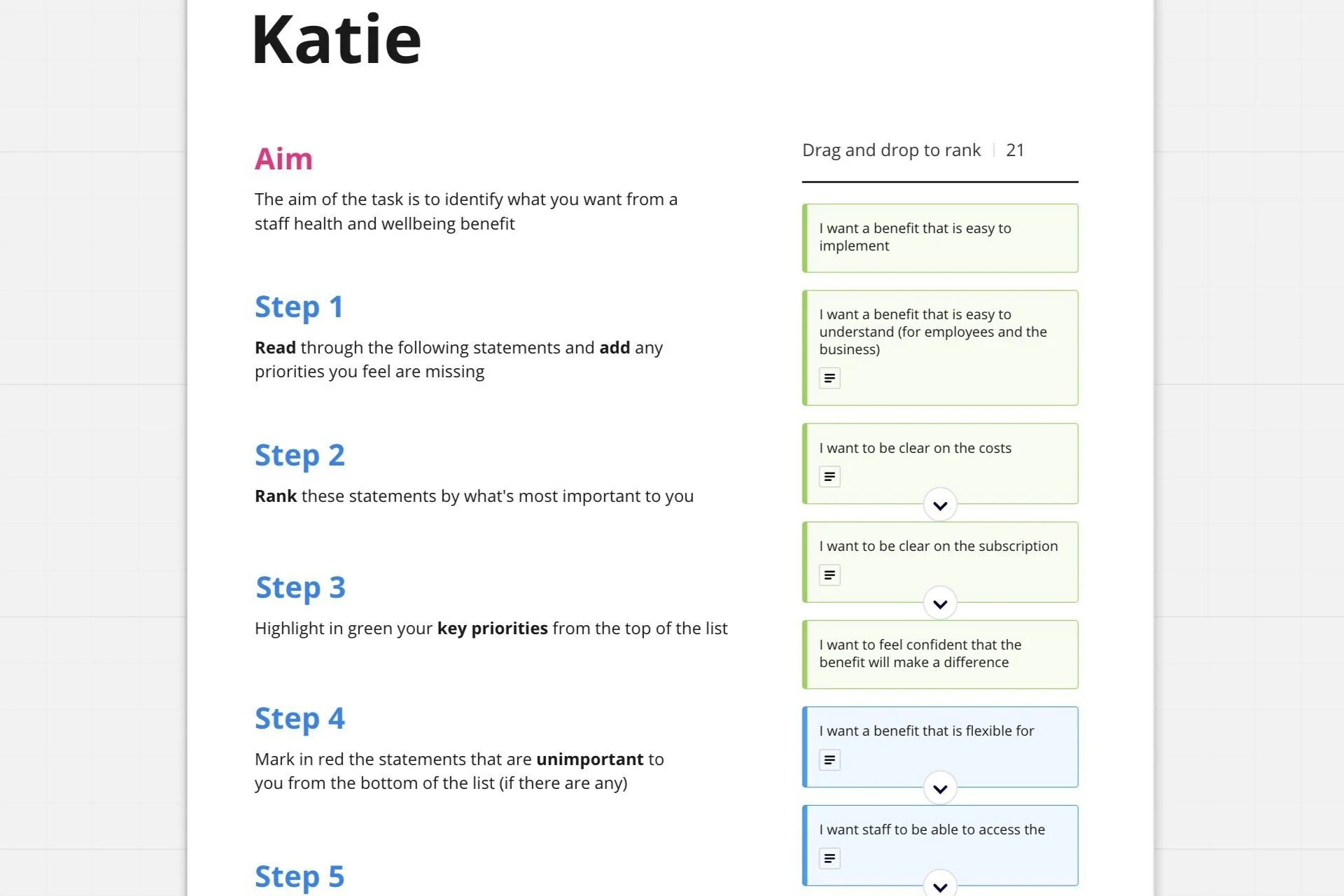
Top three priorities
1. I want to improve staff health and wellbeing
90% of participants said this was their number one priority, many referencing the impact of the pandemic: “it’s about having a happy, productive working environment… we want staff to feel we look after them.”
2. I want to feel confident that the benefit will make a difference
Participants want reassurance, backed by data and case studies, that their financial investment will pay off.
3. I want a benefit that is easy to understand
Participants emphasised accessibility for a diverse workforce: “it has to work for everyone.”
Empathy mapping
The Product team facilitated an empathy mapping exercise using Miro to capture findings from the interviews and workshops, mapping user attitudes, behaviours, needs and pain points for our two core audiences.
Personas
HR Director

- Name: Jane
- Age: 42
- Job: HR Director
- Location: London
- LiveSmart familiarity: Low
“I want to offer a health and wellbeing benefit that will make a difference to all staff.”
Bio
Jane works as an HR director in a corporate head office, managing six HR professionals and the company’s benefits budget.
Frustrations
- Wants to support the whole company with health and wellbeing, but budget is limited
- Work can be overwhelming – time and attention are constantly divided
Goals
- Wants to create a safe and happy workplace with benefits staff will actually use
- Wants a benefits package on par with companies competing for talent
- Many staff work remotely, so benefits need to be flexible
- Wants to avoid extra admin and decision-making
Employee
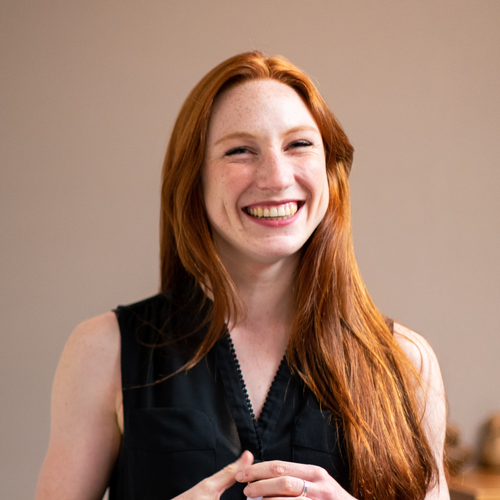
- Name: Gemma
- Age: 32
- Job: Lawyer
- Location: Manchester
- LiveSmart familiarity: Low
“I want to feel good and have more energy.”
Bio
Gemma is a career-driven lawyer at a global corporate company who understands a healthy body and mind support good work.
Frustrations
- Her busy schedule means she often feels tired and lacking in energy
- She often lacks motivation to exercise during the working week
Goals
- Wants to feel good and have more energy
- Wants to maintain her fitness and lose some weight
- Wants to know if she has any underlying health issues
- Wants a push in the right direction, but hasn’t considered speaking to her GP
Competitor analysis
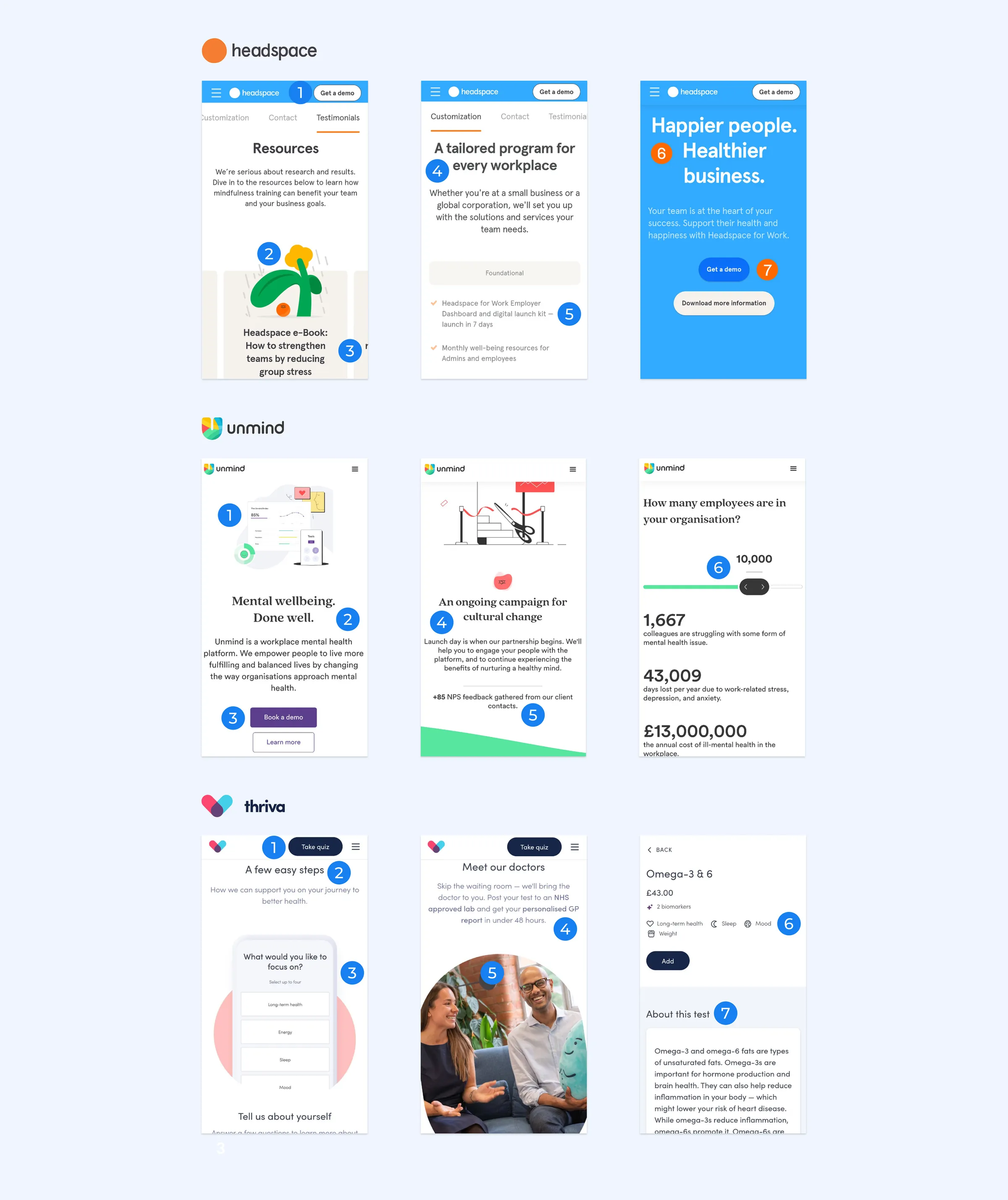
I used Miro to review various competitors’ websites, focusing on product offering, tone of voice and primary CTAs, including Headspace, Unmind and Thriva.
Brand development
Next, LiveSmart began a brand development project to translate these research insights into a clearer, more trustworthy position.
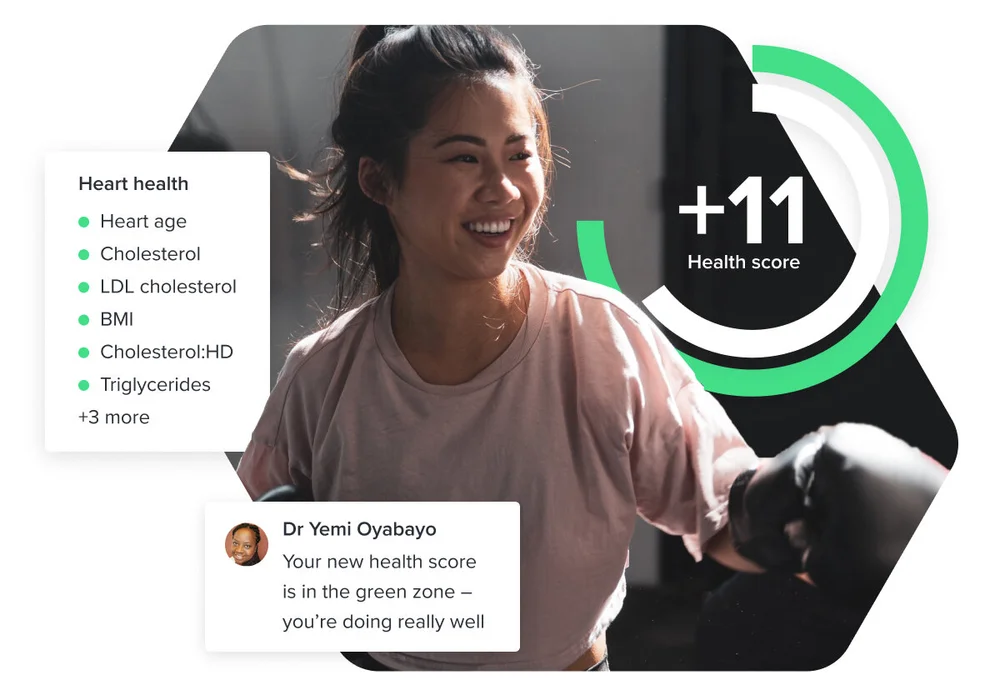
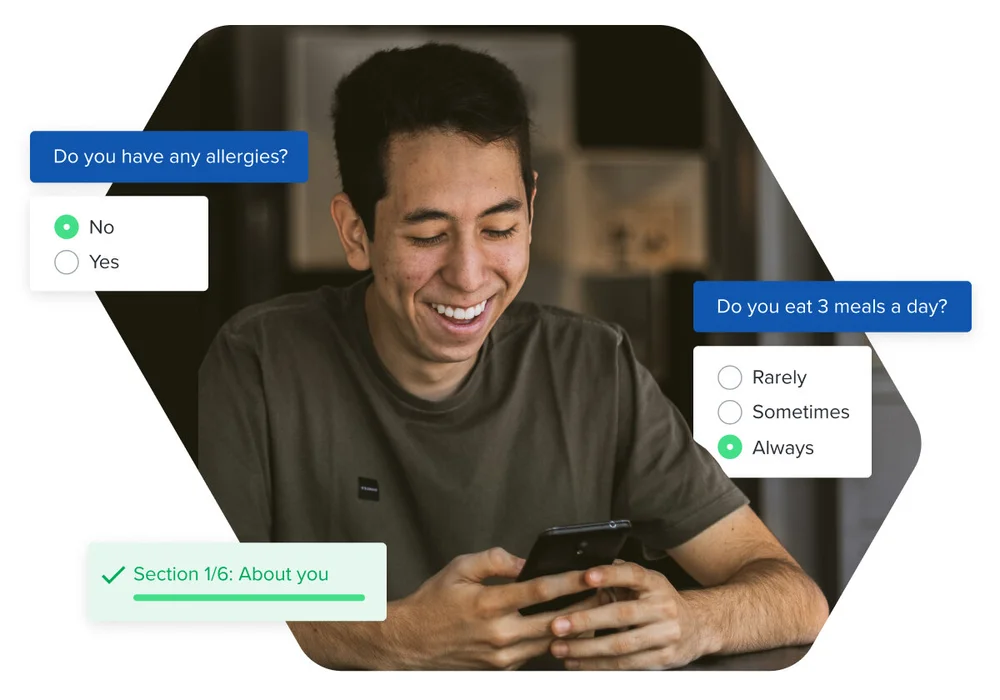
Health analytics – this is what we do. Career-driven professionals who want to be great at what they do – this is who we do it for. Greatness starts with great health – this is why we do it.
Usability testing
Round one
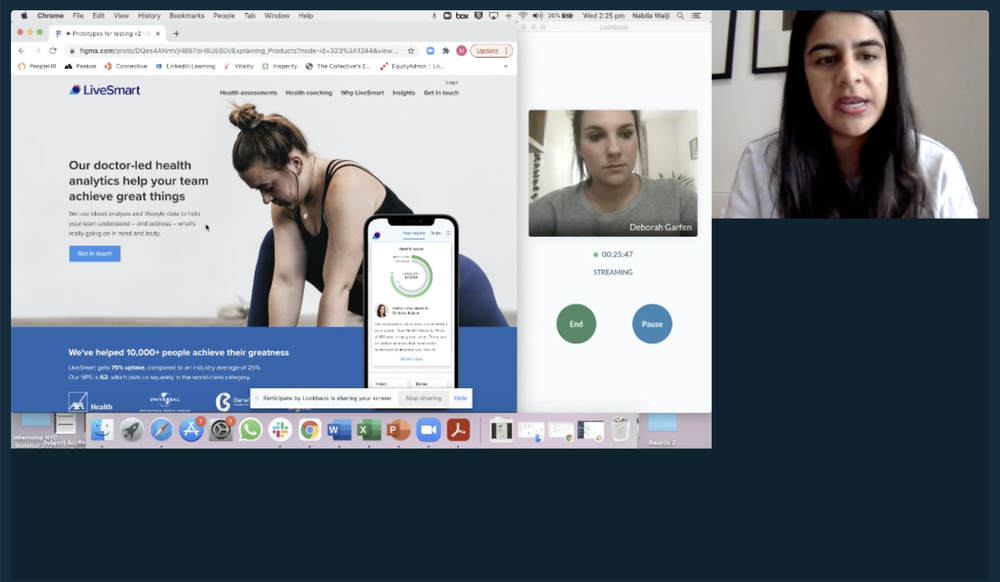
I facilitated usability testing sessions with five senior HR professionals using Lookback and a high-fidelity Figma prototype, testing the scenario: “The CEO of your company has asked the HR department to research health assessments for your company. Use this website to find out if this is the right one for you.”
Key findings
- Users didn’t know whether we were speaking to them or someone else
- Users didn’t understand the why – what does it mean for me?
Participants also showed strong interest in a tailored package, valued data-backed case studies, and wanted to gather as much information as possible before deciding.
Key recommendations
Review the homepage hero content, review the nav (‘Insights’ didn’t match expectations), introduce an ‘About us’ page, introduce data-backed case studies, and update the health assessments page to test a dedicated tailored package.
Round two
After addressing round one’s recommendations, I facilitated five more sessions with HR professionals using an updated prototype.
Key findings
- Users rated the site 8/10 on average for usefulness – “it makes a big difference if the site is user friendly and easy to understand, which this definitely is.”
- Our brand positioning resonated with all users – “it’s modern and how I would want to see a website these days.”
All users also clicked ‘Book free demo’ and explored at least two of the newly proposed pages, though some of the ‘What’s great about…’ product card copy didn’t fully resonate.
Key recommendations
Create video content to explain each area of the product, update the ‘What’s great about…’ copy, create content for at least four case studies, and further promote the free demo – while being wary of overwhelming users with information.
Website designs
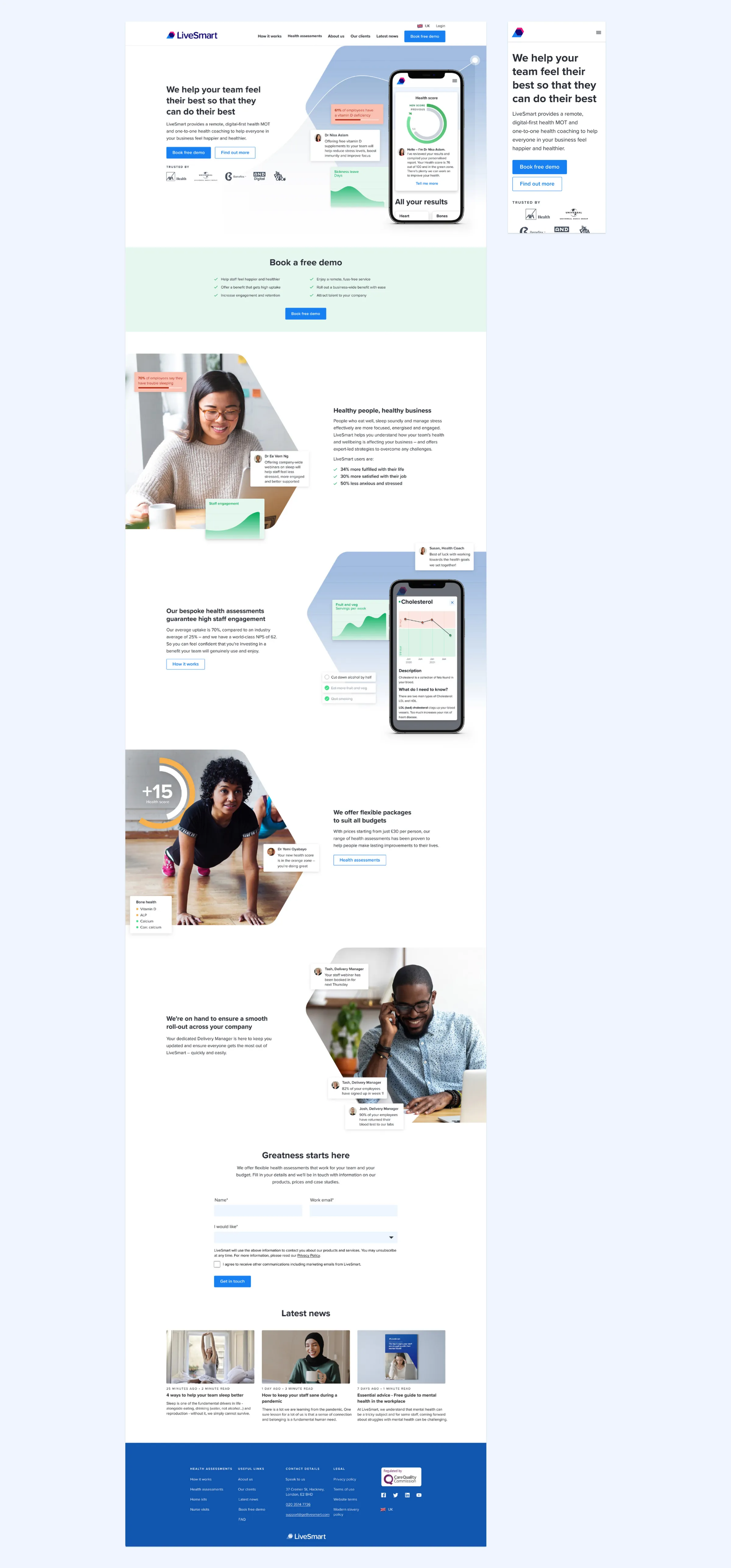
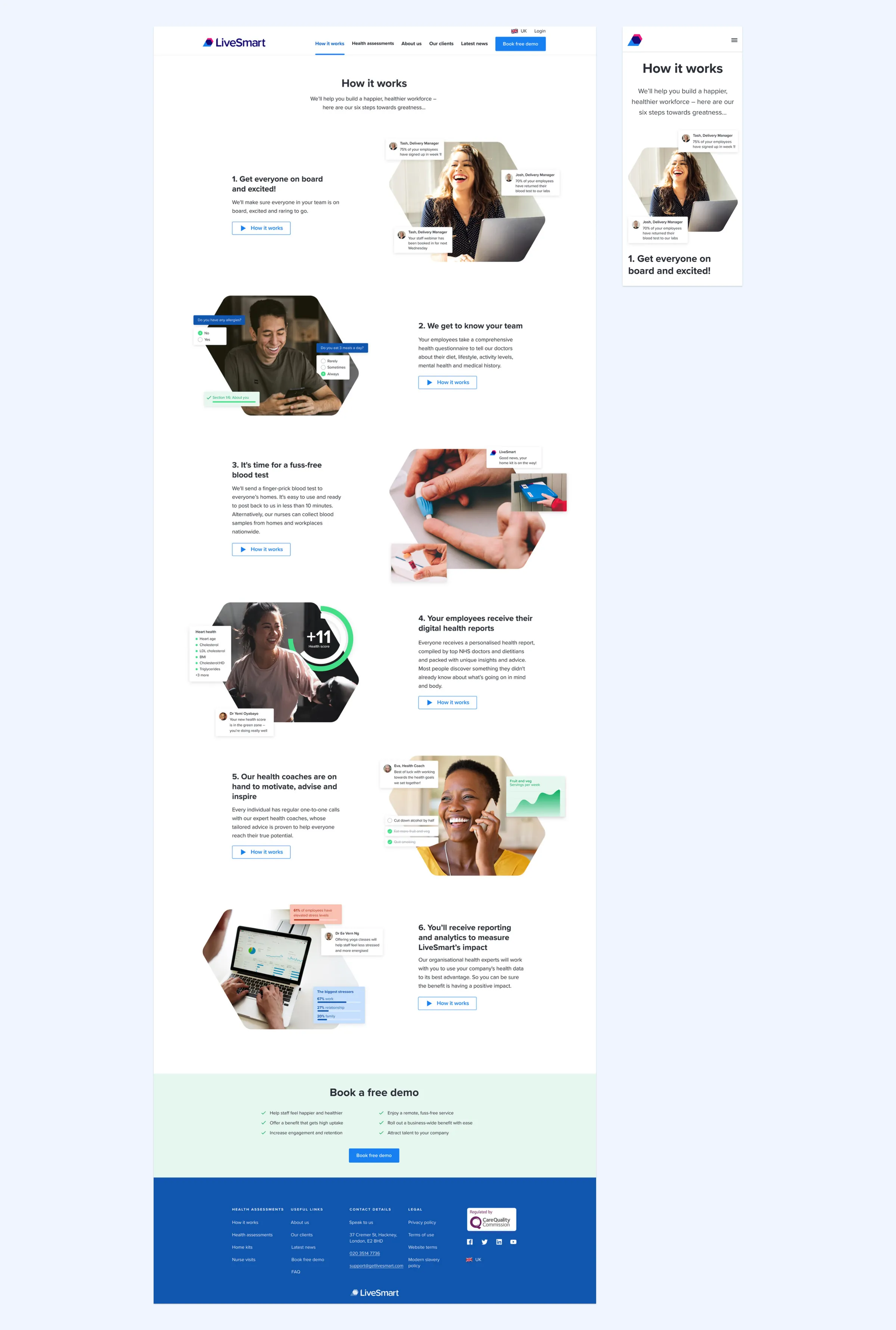
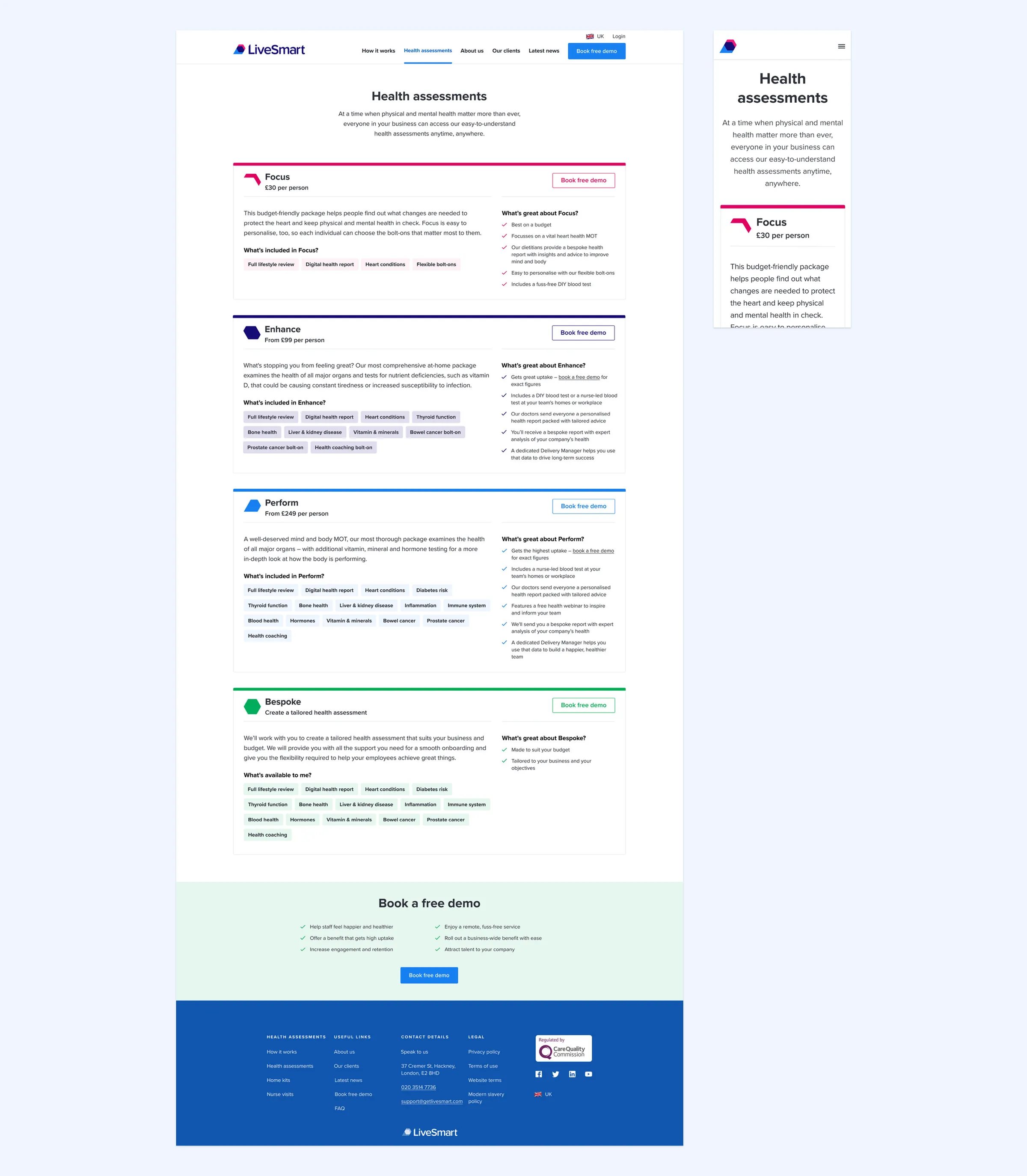
The Figma desktop and mobile design files and exported image files were handed over to LiveSmart’s Frontend Developers to build Angular components. Graphics were adapted for our French and Malaysian sites to better reflect our audiences.
Homepage
How it works
Health assessments
Testimonials
I would heartily recommend Deborah for UX/UI design, a strong ability to collaborate with the development team, and generally being a delight to work with.David, Frontend Developer at LiveSmart

Deborah brought real clarity to how we spoke to HR professionals, and worked brilliantly across our clinical, tech and brand teams throughout the project.Mat, Head of Product at LiveSmart